When you purchase through link on our site , we may take in an affiliate military commission . Here ’s how it operate .
Antarctica ’s Dry Valleys are the most desiccated places on Earth , but underneath their frigid soils lies a vast and ancient connection of salty , liquid water fill up with life-time , a novel study find .
TheDry Valleysare almost entirely ice - spare , except for a few isolated glaciers . The only surface body of water is a handful of small lakes . Inside the canyon , the climate is extremely teetotal , cold and airy ; researchers have trip upon mummified seals in these gorges that are thousands of twelvemonth old .
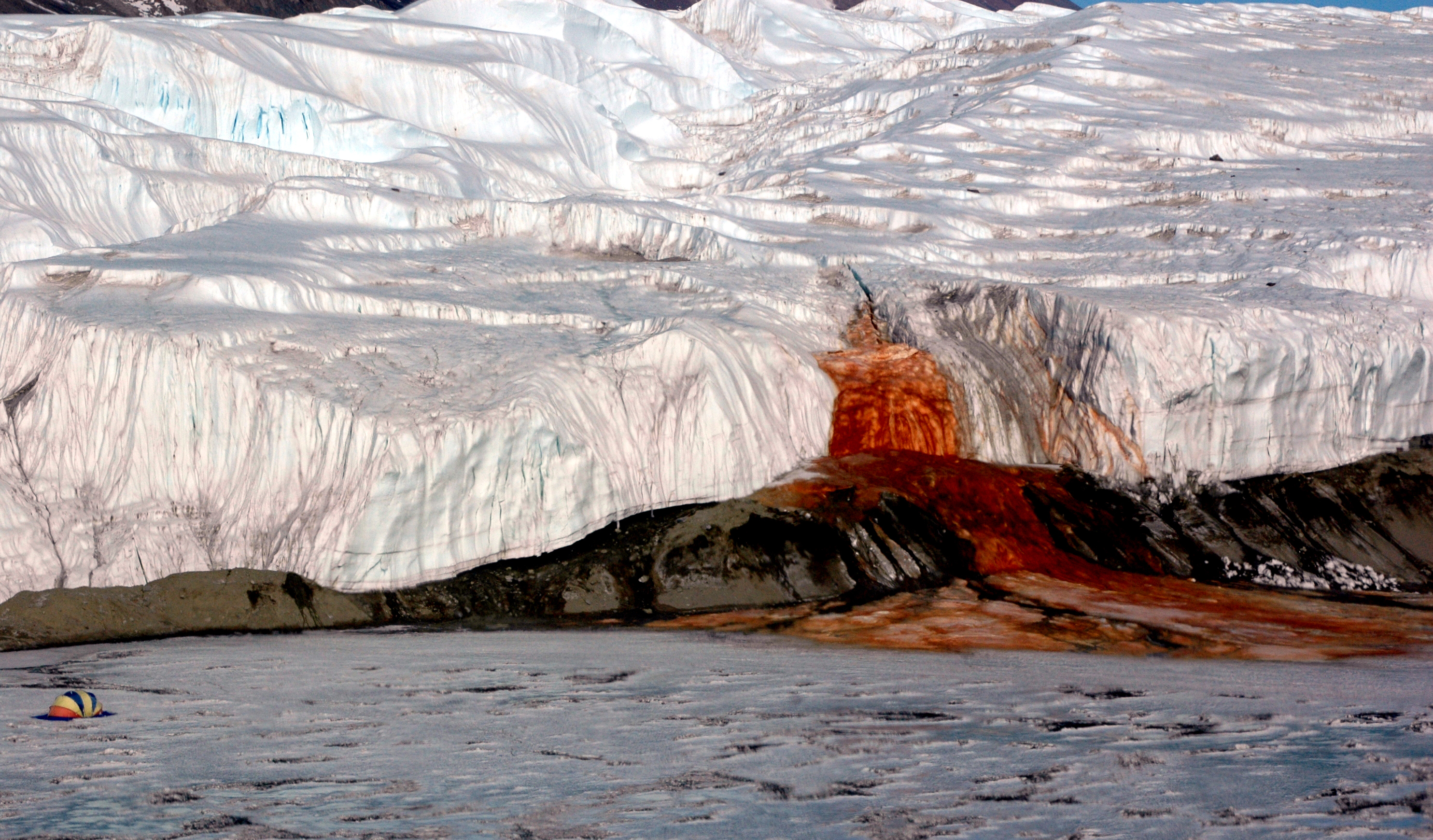
Blood Falls, Antarctica.
Yet there islife in this extreme landscape . For instance , bacterium survive under Taylor Glacier maculate its snoot a deep blood red . The rust - colored brine , telephone Blood Falls , pours into Lake Bonney in the southernmost of the three largest Dry Valleys . The dramatic color offer shocking relief to senses overwhelmed by the glare white methamphetamine and dull brown rocks . [ The 10 Driest Places on ground ]
Now , for the first time , scientist have traced the water underneath Taylor Glacier to learn more about the mysterious rip Falls . In the cognitive operation , the researchers get word that brackish water system underlie much of Taylor Valley . The subsurface connection connects the vale ’s scattered lake , revealing that they ’re not as quarantined as scientists once think . The findings were publish today ( April 28 ) in the journal Nature Communications .
Mikucki led an external research team that tested a fresh developed airborne electromagnetic sensor in Taylor Valley . The fell contraption is a large , six - sided vector suspended beneath a helicopter . The official document make a magnetic field that picks up conduction differences in the ground to a profoundness of about 1,000 feet ( 300 metre ) .
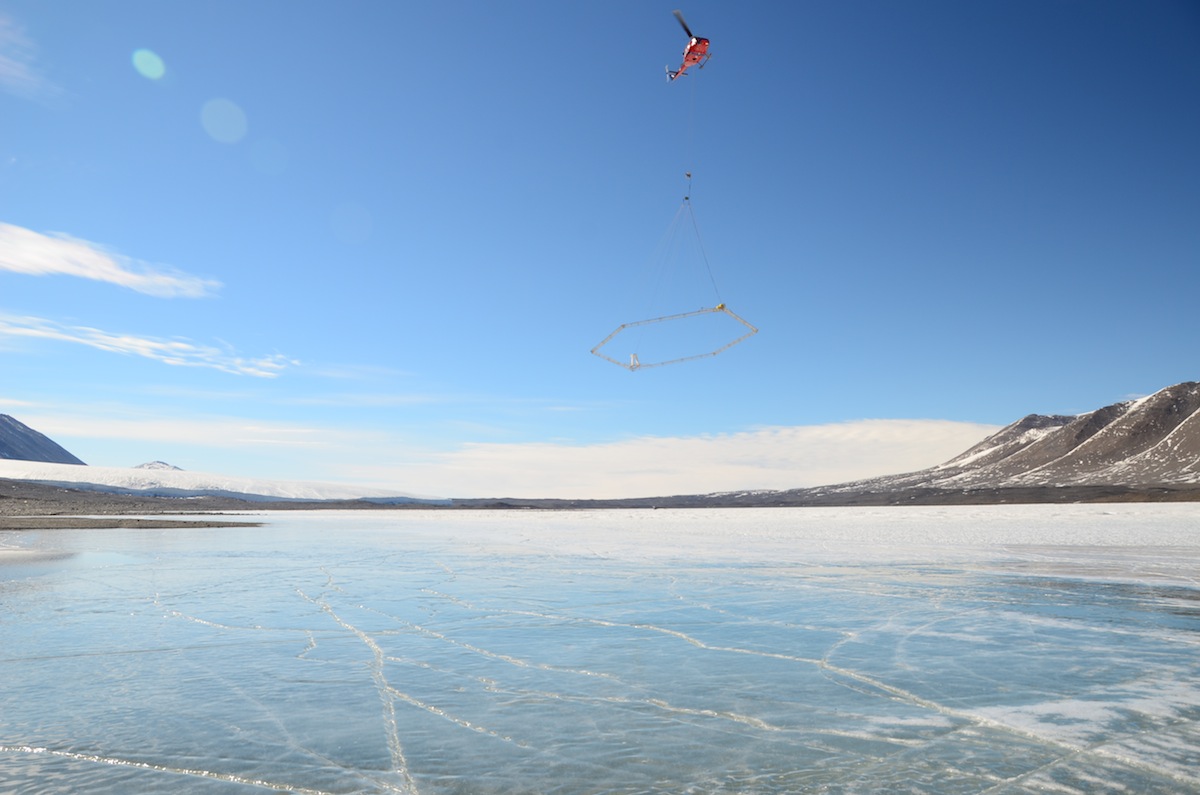
A helicopter flies a transmitter across Lake Frxyell, Antarctica.
" piquant water shone like a beacon , " Mikucki say .
The researchers discover liquid water underneath the frosty territory in Taylor Valley , stretching from the coast to at least 7.5 miles ( 12 km ) inland . The water istwice as piquant as seawater , the scientists describe . There is also brackish water underneath Taylor Glacier as far back as the official document could detect , about 3 miles ( 5 km ) up the glacier , the researchers said . Eventually , the shabu was too thick for the magnetic field to penetrate .
" This study shows Blood Falls is n’t just a unearthly little seep , " Mikucki assure Live Science . " It may be representative of a much larger hydrologic mesh . "

pee underneath Taylor Valley could have turned extremely salty in two ways : The brines could be due to freezing and evaporation of larger lakes that once filled the vale . Or , sea water supply may have once inundate the canyon , leaving remnant behind as it retreated . The new findings will help research worker immobilise down the valley ’s aquatic account .
" I encounter it a very interesting and exciting study because the hydrology of the Dry Valleys has a complicated history and there ’s been very little data border what ’s happening in the subsurface , " say Dawn Sumner , a geobiologist at the University of California , Davis , who was not involve in the study .
Scientists are also connive by the new results because the Dry Valleys are considered one of the closest analogs to Mars that are site on Earth . standardised brackish groundwater could have formed onMarswhen the planet transition from having liquid weewee to a dry environment , Sumner say .

Finally , the findings may exchange panorama of Antarctica ’s coastal margins , Mikucki read . Now that scientists know Taylor Valley ’s groundwater seep into the ocean , further research may divulge that coastal regions are important nutrient sources for Antarctica ’s smoothing iron - depleted sea , she said .