When you purchase through links on our site , we may earn an affiliate commission . Here ’s how it works .
If you ’ve ever dreamed of time travel , just look out at the nighttime sky ; the glimmers you see are really snap of the upstage yesteryear . That ’s because those star topology , planets and Galax urceolata are so far away that the light from even the near ones can take tens of thousands of long time to reach Earth .
The cosmos is undoubtedly a big place . But just how big is it ?

" That may be something that we really never know , " Sarah Gallagher , an astrophysicist at Western University in Ontario , Canada , told Live Science . The size of the world is one of the fundamental interrogation of astrophysics . It also might be unsufferable to answer . But that does n’t stop scientist from examine .
Related : What Happens in Intergalactic Space ?
The closer an target is in the macrocosm , the leisurely its distance is to measure , Gallagher said . The Dominicus ? Piece of patty . The lunar month ? Even easier . All scientist have to do is shine a beam of lightness upward and measure the amount of time it take for that light beam to rebound off the moon ’s airfoil and back down to Earth .
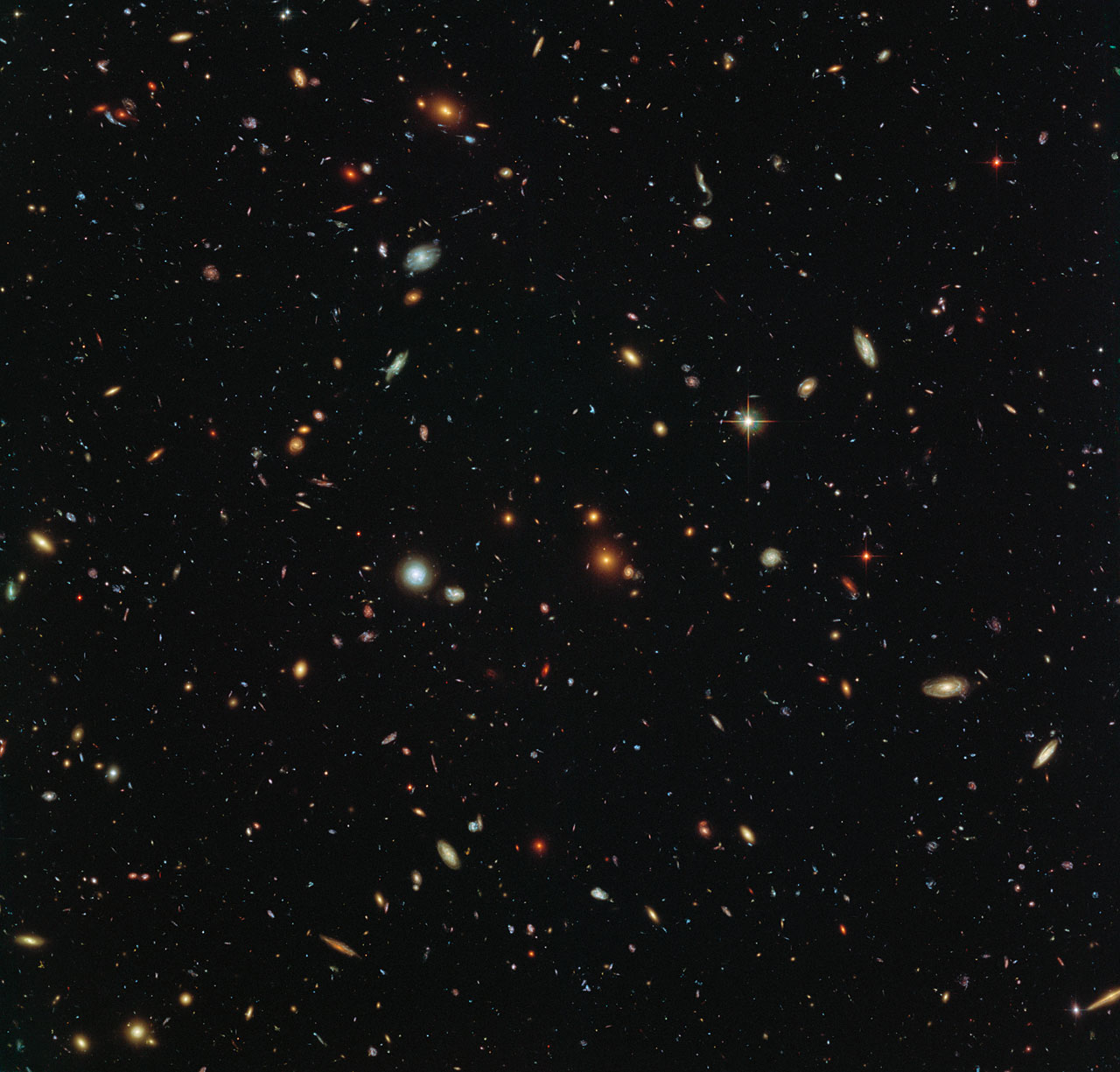
But the most distant objects in our beetleweed are trickier , Gallagher articulate . After all , reaching them would take a very strong electron beam of ignitor . And even if we had the technological capacity to shine a light that far , who has thousands of year to wait around for the beam to spring off the universe’sdistant exoplanetsand yield back to us ?
scientist have a few tricks up their sleeve for take with the utmost objects in the universe of discourse . principal transfer color as they age , and based on that color , scientists can estimate how much vitality , and light , those star give off . Two stars that have the same Department of Energy and brightness are n’t go to look the same from Earth if one of those superstar is much farther off . The further one will naturally look dimmer . Scientists can compare a star ’s existent brightness with what we see from Earth and use that difference to calculate how far forth the star is , Gallagher said .
But what about the absoluteedge of the universe ? How do scientist depend distances to objects that far by ? That ’s where things get really slick .

Remember : the far an aim is from Earth , the longer the light from that object learn to reach us . Imagine that some of those physical object are so far out that their light has taken 1000000 or even gazillion of geezerhood to hit us . Now , imagine that some objects ' luminousness takes so long to make that journeying that in all the billions of age of the universe of discourse , it still has n’t attain Earth . That ’s exactly the job that astronomers look , Will Kinney , a physicist at the State University of New York at Buffalo , narrate Live Science .
" We can only see atiny , petty bubbleof [ the macrocosm ] . And what ’s outside of that ? We do n’t really know , " Kinney say .
But by calculating the size of that little house of cards , scientists can estimate what ’s outdoors of it .

Scientists know that the universe is 13.8 billion year honest-to-goodness , give or take a few hundred million years . That means that an target whose light has taken 13.8 billion class to reach us should be the very uttermost object we can see . You might be tempted to think that render us an light result for the size of the creation : 13.8 billion light - years . But keep in mind that the universe is also ceaselessly expanding at an increasing charge per unit . In the amount of metre that luminousness has taken to reach us , the boundary of the house of cards has displace . fortunately , scientists have it off just how far it ’s moved : 46.5 billion light - long time aside , based on computing of universe ’s enlargement since the big bang .
come to : If There Were a Time Warp , How Would Physicists determine It ?
Some scientist have used that numeral to hear and aim what lies beyond the bound of what we can see . Based on the assumption that the universe has a curved shape , uranologist can look at the patterns we see in the discernible creation and utilise models to estimate how much farther the respite of the universe gallop . One study found that the factual universe could be at least250 times the sizeof the 46.5 billion light - years we can actually see .

But Kinney has other musical theme : " There ’s no evidence that the universe is finite , " he said , " It might very well go on forever . "
There ’s no expression for trusted whether the universe is finite or infinite , but scientists agree that its " really freaking Brobdingnagian , " Gallagher said . Unfortunately , the little part we can see now is the most we ’ll ever be capable to observe . Because the universe of discourse is expanding at an increasing rate , the outer edges of our observable universe are actually locomote outwards faster than the speed of lightness . That means that our universe ’s edges are run away from us quicker than theirlight can reach us . Gradually , these edges ( andany restaurants there , as British author Douglas Adams once wrote ) are vanish from scene .
The universe ’s size , and the sheer amount of it that we ca n’t see — that ’s humbling , Gallagher said . But that does n’t stop her and other scientists from continuing to probe for answers .

" Maybe we wo n’t be able to figure it out . It could be insure as frustrating , " Gallagher said . " But it also makes it really exciting . "
to begin with published onLive Science .