When you purchase through link on our site , we may earn an affiliate committal . Here ’s how it shape .
It ’s kind of like walking direct into an electrical fence , or getting shoot with a stun gun . That ’s how one life scientist describes the experience of getting atomize by an galvanizing eel .
" You would n’t voluntarily do it over and over again , " enjoin Kenneth Catania , a professor of biological sciences at Vanderbilt University in Nashville , Tennessee , and generator of a Modern discipline about theelectric eels ' shocking behavior .

An electric eel curls its body to deliver a powerful shock to a prey item.
Catania has been zapped a few times since he began studying the electric eel ( Electrophorus electricus ) , a fish that ’s indigenous to the mirky water of the Amazon . Endowed with three electricity - bring forth organs , E.electricuscan send a pulsing , or volley , of high - voltage electricity through the piss toward prey item . These shock are n’t intend to drink down the prey , just demob it so the eel can more easily consume its victims , Catania narrate Live Science . [ TV : find out an Electric Eel Curl Around Its Prey ]
To envision how the eel uses its electric bursting charge , examine visualize the critter ’s long , thin body as a skinny magnet . Like a magnet , the eel has two end , or poles . When the animal place out an electric pulse , most of the charge comes from its head , which Catania call the " positive rod . " The eel ’s tail serve as the " negative pole , " sending out a much weaker electric heart rate than the head , Catania say .
Most of the prison term , E.electricusjust take the charge from its capitulum to inactivate target . However , the bum close of the eel is actually quite important , Catania ’s new study show . By bringing its tail around toward its promontory , an galvanising eel can double the enduringness of the electric pulse it sends out into the piddle , allowing it todemobilize larger prey point , the study found .
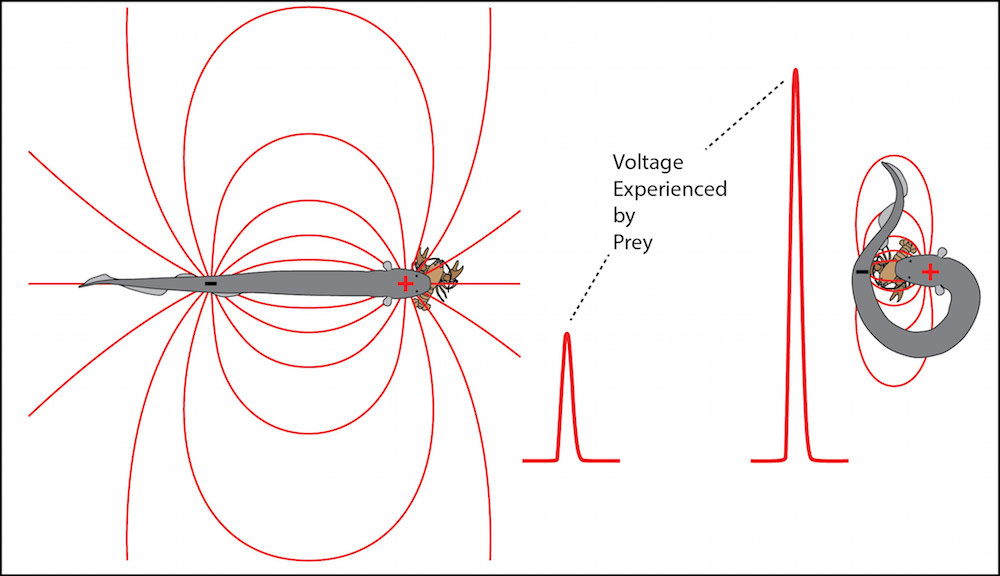
An illustration of the eel’s curling behavior.
To measure the energy output of a curl eel , Catania rigged up a sort of eel cud toy by tie a dead fish to a piece of telegram . The fish was fitted with electrodes that could evaluate the potential raise by the eel . Then , Catania cohere the chew toy dog in the tank with the eel and wiggled the toy around , simulate struggling prey . for certain enough , the eels tended to wrap up themselves around the Pisces the Fishes , and when they did so , they delivered at least twice their usualzap of electricity , Catania found .
To understand how the eel double its armorial bearing , try picturing the critter in the build of a horseshoe magnet . In one of these U - shaped magnets , the north and south pole of a single attractor are brought into close proximity to one another , which createsa strong magnetic field . When the eel lock up in this horseshoe shape , something standardized happens — it grow a inviolable electric field .
" When the eel curls its positive and negative poles together and sandwiches the prey in between , you get a focalisation of the galvanizing playing field , " Catania said .

But electric eel do n’t in reality double the amount of electricity they produce when they go after large prey ; they just direct the commission from both death of their bodies to one specific area , which name the charge feel more sinewy to inauspicious prey item . This is a good tactic for an eel to use , say Catania , adding that the zappy critter do n’t have to expend any more vim than usual when they draw in up like this , but they could still terminate up with a bigger meal .
Small eels ( some are just a few inch long ) do a passel of curling , said Catania , who pointed out that these small animals need to focus their zaps to stun quarry into submission . But big eels , which can measure a meter or two in distance , engage in this demeanor , as well . Catania say he ’d care to know more about what kinds of target items these large eel can take down with their knock-down electrical charges .
" There ’s virtually no grounds of what electric eels really deplete . But these guys get really large , and they survive in the Amazon , where there ’s a huge diversity of possible prey , " said Catania , who supply that galvanising eels could wrestle all kinds of animate being . He said he hopes his new subject field might get other researchers wonder just what the galvanizing eel is capable of hunting in the wild .